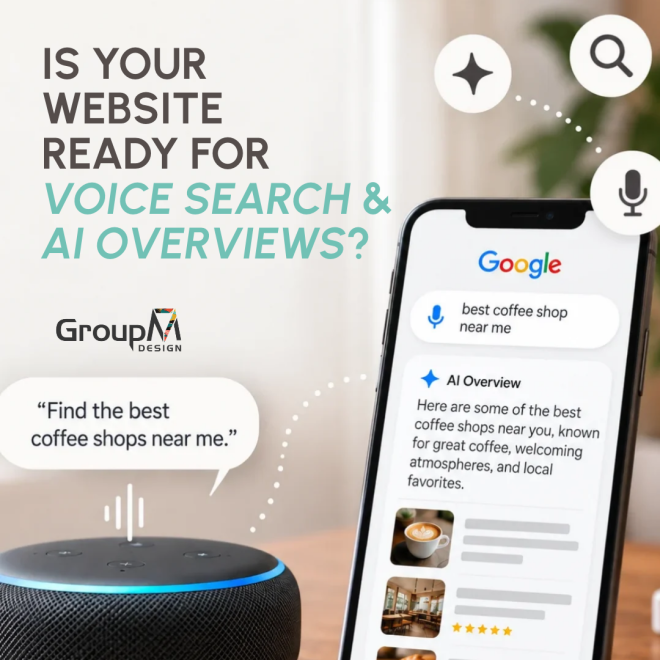
Is Your Website Ready for Voice Search and AI Overviews?
The way people search is changing.
Your customers are not always sitting at a computer typing a few keywords into Google anymore. They are asking Siri a question in the car, talking to their phone, or typing a full question into Google and getting an AI-generated response before they ever scroll through the traditional search results.
That creates a new challenge for businesses: When someone asks a question your business can answer, can search engines and AI systems understand your website well enough to find that answer?
Traditional SEO still matters. In fact, Google says the same foundational SEO practices apply to its AI search features. But as search becomes more conversational, having a website that simply mentions the right keywords is not enough. Your content needs to be clear, useful, accessible, and easy for both people and search engines to understand.
Your Customer Is Searching Differently
Think about the difference between something you might type into Google and something you might ask out loud.
You might type “web design Tyler TX.” But when using voice search, you may ask, “Who builds websites for small businesses in Tyler?” Or instead of searching “foundation repair,” someone might ask, “How do I know if the cracks in my house are a foundation problem?”
The intent may be similar, but the language is different.
That is why businesses need to think beyond individual keywords and start thinking about the actual questions their customers are asking. What problems are they trying to solve? What information do they need before making a decision? What would they ask you if they were standing in front of you?
Your website should answer those questions clearly.
AI Overviews Change What It Means to Get Found
Google's AI Overviews and AI Mode can generate responses using information from multiple sources across the web. That means search is increasingly becoming about more than earning one of the traditional blue links. Your content may also have an opportunity to be used or cited as a supporting source within an AI-generated answer.
There is not a special button you can push to guarantee that your website appears in an AI Overview. Google specifically advises site owners to continue following its established SEO best practices rather than chasing special tricks for generative AI search.
The goal is still to create a website that makes it easy for Google to understand who you are, what you know, what you offer, and why your content is useful to the person searching.
That starts with clarity.
Stop Making Search Engines Guess
Imagine a potential customer lands on your website looking for an answer to a simple question, but your homepage is filled with vague statements like “Delivering innovative solutions” or “Committed to excellence.”
Those phrases might sound good, but what do they actually tell the customer? Not much.
The same problem applies to search engines and AI systems. If your website does not clearly explain what your business does, where you operate, who you serve, and what questions you can answer, you are making it harder for search technology to understand your business.
Good website content should make those things obvious. Your service pages should explain individual services in detail. Your headings should tell people what the page is actually about. Your location information should be accurate. Your blog should answer real questions instead of existing just to publish more keywords.
In other words, write for your customer first, but make your information easy for technology to understand too.
Answer the Questions Your Customers Are Already Asking
One of the simplest ways to prepare your website for conversational search is to listen to your customers.
What do they ask before requesting a quote? What concerns come up during sales calls? What do people misunderstand about your services? What questions does your team answer over and over again?
Those questions are content opportunities.
A pool builder might answer, “How long does it take to build a pool?” A CPA firm might explain, “When should a small business hire a CPA?” A commercial contractor might answer, “How much does a commercial construction project cost?”
Instead of building around awkward keyword phrases, build it around the conversations your customers are already having.
Clear questions followed by useful, direct answers make your website better for people first. They also give search engines more context about your expertise and the topics your business covers.
Make Sure the Technology Behind Your Website Can Keep Up
Good content is only part of the equation. Your website also needs a strong technical foundation.
Search engines need to be able to crawl and index your pages. Your site should work well on mobile devices, load efficiently, use clear page structures, and make important information accessible. Google also supports structured data, which gives search engines additional clues about what information on a page represents, such as an organization, local business, article, product, event, or other supported content type.
Structured data is not a shortcut to better rankings, and implementing it does not guarantee a special search result. It is simply another way to help search engines understand your content.
And as search continues to evolve, that understanding matters.
Your Website Should Be Part of a Bigger Digital Ecosystem
Your website does not work alone.
Someone might hear your business mentioned, search your name, see your Google Business Profile, read your reviews, visit your website, check your social media, and then come back days later with a more specific question.
Every one of those interactions helps them decide whether they trust you.
Your website should be the place that brings everything together. It should clearly explain the problem you solve, answer the questions your customers have, demonstrate your expertise, and give them an obvious next step.
That is good messaging. It is good user experience, and it also happens to create the kind of clear, useful content modern search engines are trying to understand.
So, Is Your Website Ready?
You do not need to completely rebuild your website every time search technology changes. But you do need to make sure your website is keeping up with the way your customers actually look for information.
Start by asking a few simple questions:
Does your website clearly explain what you do and who you help?
Does it answer the questions customers actually ask?
- Do you have useful content beyond your homepage?
- Can Google easily crawl and understand your pages?
- Is your website fast, mobile-friendly, and easy to navigate?
- Does each page give the visitor a clear next step?
If the answer to several of those questions is no, the issue is bigger than voice search or AI.
Your website may not be doing enough to help people find you in the first place.
Build a Website That Is Ready for How People Search Now
Your customer has a problem. They are looking for an answer, and increasingly, they are asking for that answer in new ways.
Your job is not to chase every new search trend. Your job is to make sure that when someone asks a question you are qualified to answer, your business has created something worth finding.
At GroupM7, we build websites with the bigger digital ecosystem in mind, combining web design, web development, SEO, content, and digital marketing to help businesses become easier to find and easier to choose.
Search is changing. Your website should be ready for it.
Wondering how your current website holds up? Let’s take a look.
Most Recent
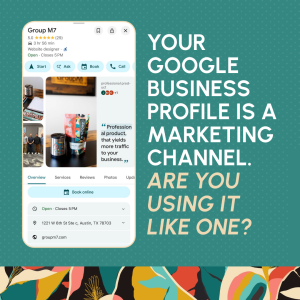
Your Google Business Profile Is a Marketing Channel. Are You Using It Like One?
Your Google Business Profile is often the first thing a potential customer sees when they search for you. Before they visit your website, scroll through your social media, or pick up the phone, they may already be looking at your photos, reviews, hours, services, and location.
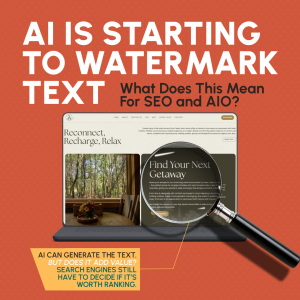
AI Is Starting to Watermark Text. What Does That Mean for SEO and AIO?
AI-generated content is getting harder for the human eye to spot, but it may be getting easier for machines to recognize.Anthropic recently announced it will watermark AI-generated content. The technology can place an imperceptible watermark within AI-generated text. Unlike a watermark on an image, you won't see a logo, label, or disclaimer when you copy and paste the content.

Summer Is Winding Down. Is Your Marketing Ready for What Comes Next?
If your marketing has been the thing sitting on the back burner while summer happened around you, you are not alone. But fall is coming fast, and the businesses that hit the ground running in the fall are the ones doing the work right now.Before you grab that last weekend on the lake, here is what we want you to think about.

You Want Leads. But Does Anyone Know Who You Are Yet?
You started your business to make money, not to be famous.So when it comes to marketing, the goal feels obvious. You want leads. You want the phone to ring. You want the form to fill out. You want customers, not followers.That instinct is right. Leads keep the lights on. Leads pay your team. Leads are the difference between a business that survives and one that closes its doors.But here is the problem almost every business runs into, usually without realizing it.People do not buy from businesses they have never heard of.